
Minnesota water — the lake looks pretty calm,
but underneath the surface there’s a battle ragin’ on
—from a 1997 poem by Mille Lacs County resident Sue Lyback
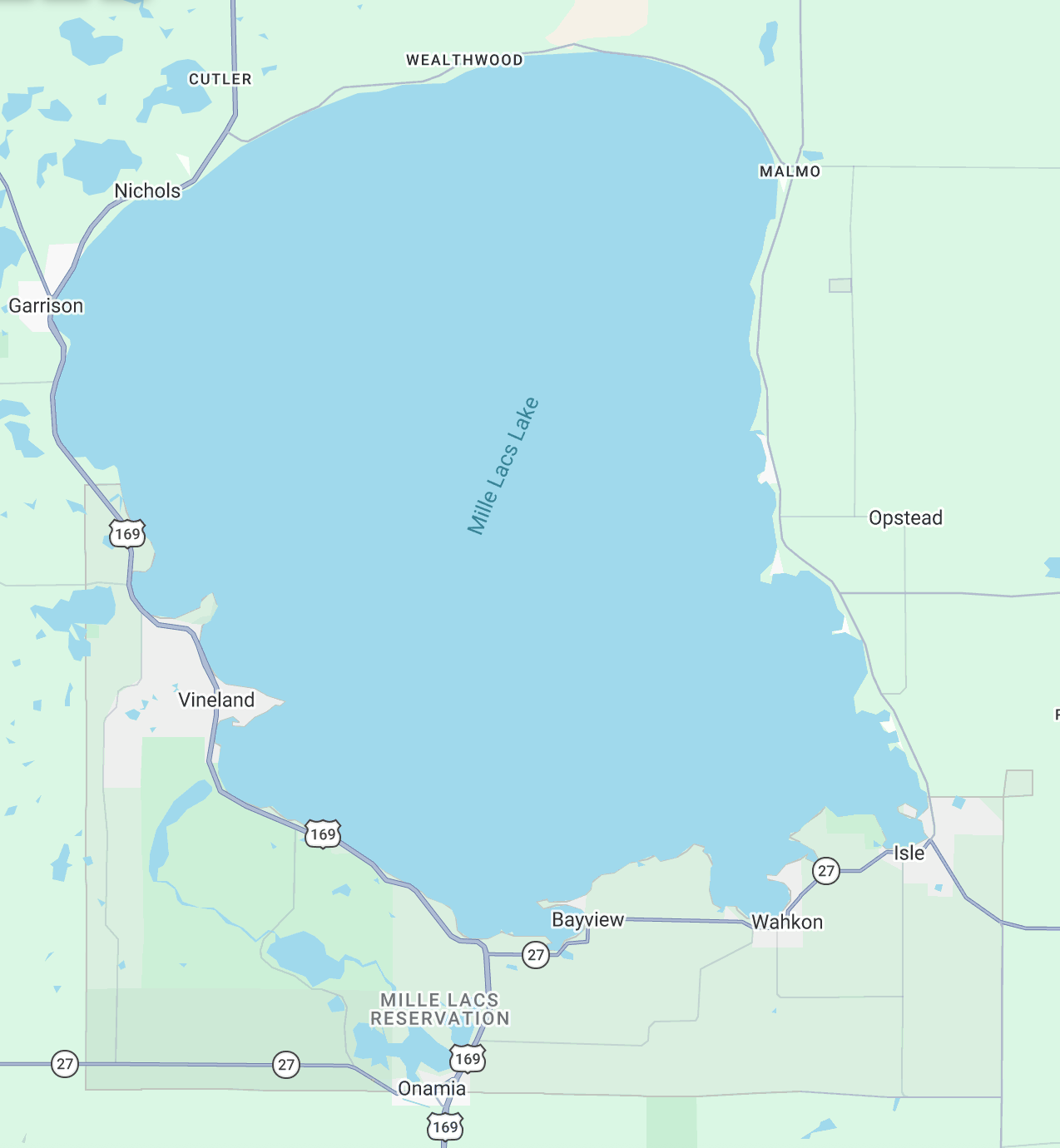
On the southern shore of Mille Lacs lake, a 206-square-mile body of water surrounded by forests of oak and maple, some 4,600 people live in seven towns and townships with names like Onamia, Isle, and Wahkon. They live on roads like Lakeshore Boulevard, Lake Avenue, and Lake Street.
It is usually quiet here outside of summer weekends. The VFW and local churches hold bingo games, and locals and weekenders alike play pulltabs—tear-off gambling cards—in the bars and lakeshore resorts. On Fridays the Onamia bank serves popcorn, and the newspaper publishes each week’s bowling scores.
Awaiting you on the scenic byway are tackle, bait, and gun billboards; yard signs for meat raffles and firewood bundles; churches advertising early service, along with roadside art of Paul Bunyan the lumberjack and a mural of a walleye—the state fish—on Isle’s water tower. Between towns you can see leaning grain silos and collapsing red-flaked barns, mobile homes and tiny farmhouses.
To many Minnesotans this appears to be the north end of Mille Lacs County, a rural region two-hours beyond the Twin Cities, where more than 4 million tourists sought adventure a weekend at a time in 2023, according to the state’s tourism agency. For locals, including some who trace their roots to pioneer days, the region offers something akin to frontier living, where every aspect of life is defined by the “walleye capital of the world,” a contested title that nonetheless befits the second-largest of Minnesota’s 10,000 lakes.
But this is not Minnesota, or even America. It’s the Mille Lacs Reservation, a sovereign tribal nation. And its borders are in serious dispute.
The Mille Lacs Band of Ojibwe, who found themselves surrounded by the new state of Minnesota in 1858, ceded land across the region in exchange for a “permanent home” of 61,000-acres of lakeside land within three sets of coordinates plus “the three islands in the southern part of Mille Lac [lake].” The federal government and the state of Minnesota recognize these boundaries today.
But some non-Indigenous people inside the reservation do not. They insist the larger reservation is long gone, and they’re not entirely mistaken. Treaties, laws, tricks, and time have swindled most of the land from the Ojibwe and eroded the physical evidence of a reservation. According to this vocal part of the white community, only some 4,000-acres of land held in trust by the federal government on behalf of the Band can technically be referred to as a reservation.
As a result of these conflicting interpretations, since 2017 the Band and the County have waged a legal battle, under the pretense of a police jurisdiction dispute, to try to determine once and for all whether the Mille Lacs Reservation is still 61,000-acres—roughly the size of Milwaukee—or only 4,000.
What’s at stake?
Although some of them don’t believe it, very little would change for the white residents if the courts agreed that they live in a reservation. They already own most of the land and federal laws protect their personal property rights, reservation or no. Plus they would remain under county and state jurisdictions. The Supreme Court has heavily restricted tribal authority over non-Indigenous people living within reservations, meaning white residents remain with the same personal liberties. Perhaps the largest change may be greater federal environmental oversight, if it even comes to that.
The Band, in turn, risks losing its right to self-governance and authority over its homeland: sovereignty, in a word, over its nation. Their reservation’s size would be reduced drastically and their already limited criminal and civil jurisdictions would only apply to the 4,000-acres of land held in trust by the federal government.
These tensions aside, something else flows beneath the legal and jurisdictional debate: two big shifts that have unsettled expectations of where whites and the Ojibwe fall on the social and economic ladder.
Since the 1980s, the local white people’s main means of living—a cottage resort industry and exploitable fishery—has declined, as recreational tastes changed and fishery regulations accumulated. Many stalwart businesses and local legends of this blue-collar paradise have disappeared, replaced by luxury cabins, RV sites, and Twin Cities commuters that have atomized the community.
Meanwhile, the revenues from two casinos the Band opened in the 1990s have uplifted the lives of some 4,800 Band members. Gambling has paid for infrastructure, homes, and clinics for the Ojibwe that didn’t previously exist. The Band became a financial powerhouse that owns multiple hotels and businesses, a marijuana grow facility, and even the naming rights to the Minnesota Wild hockey team’s St. Paul arena. That money also paid for the litigation that in 1999 forced Minnesota to recognize resource rights guaranteed to the Band in an 1837 treaty—including a right to a portion of all the fish in Mille Lacs lake.
But white locals are afraid the Band is hungry for more than walleye. Anti-Indigenous activists have seized on the changing fortunes of local whites to argue that the Band is at fault. That it has driven away tourists, killed family businesses, and demolished a cultural legacy. They claim the Band wants to take back the rest of the 61,000-acres and exercise absolute authority over it and the whites within. And some locals, and their elected representatives, are listening.
The County Board of Commissioners has tried to use the courts to end all claims that the 61,000-acre reservation remains intact. Most recently the case landed in the Eighth Circuit Court of Appeals—the latest battle for this homeland between the striving settlers who came to tame the land and the Indigenous peoples who were there first.
“We had the lake”
Mille Lacs lake began as a glacial pockmark fifteen thousand years ago, later filled with melted ice and sustained by streams and rain, feeding eventually into the Mississippi River. Forests grow atop glacial boulders and surround the lake’s cold muddy waters and rocky reefs, home to some eight fish species.
Humanity’s presence dates back to 3000 B.C., although the Dakota were the first identifiable Indigenous people to live here, calling the lake Mde Wakan—Spirit Lake. They were displaced in the 1700s by the westward migrating Ojibwe, who named the inland sea Misi-zaaga’igan, or Grand Lake. French fur traders eventually bestowed Mille Lac or Thousand Lakes upon it, its pronunciation corrupted by waves of European immigrants in the 1800s whose descendants pronounce it as “mill lax.”
Before white settlers homesteaded the region, Ojibwe people subsisted off the natural resources available to them. They lived in a mix of seasonal and permanent structures, and engaged in trade among other tribal nations. Life was not easy, but neither was it impoverished.
Yet by the 1900s subsistence living declined as the open spaces were closed off by property lines. “When I was young here there was no resorts in the area,” said tribal member Doug Sam, in a 1992 interview with the Minnesota Historical Society. ”You could move freely around the lake.”
Whites arrived in the late 1800s to homestead and log the region’s white pine forests—ancient conifers sometimes five feet in diameter and a hundred feet tall, according to the Mille Lacs Messenger. In the 1890s nearly 40 million feet of logs a year were sent downriver. White pine forests disappeared after logging peaked in 1900 with 2.1 billion feet of white pine lumber, and the white communities at Mille Lacs lived off of farming, pickling, dairy operations—and soon, tourism.
An economy of relaxation and outdoor exploration took off at the lake, its shorelines eventually swarmed by family-run resort businesses. It was and still is a precarious economy: a bad season when the fish don’t bite—called dead sea years colloquially—can ruin anybody.
Today 27,500 people live in Mille Lacs County, a 685-square mile jurisdiction shaped like a rectangle on its end, whose northern boundary terminates halfway through the lake. The population is 90% white, the next largest group being the 5.5% that identify as Native American. The median household income is $71,000 a year, compared to Minnesota’s median of $85,000, and nearly 11% live in poverty. Many work in healthcare or in the service industry.
Census Bureau data also separates out the 61,000-acre reservation. In 2024 nearly a seventh of the County’s population lived there off $56,000 a year. Sixty-five percent of people within the boundaries were white, followed by the 25% that identified as Native American. Over half the population lives in four places: Isle, Onamia, Wahkon, and unincorporated Vineland, the only predominantly non-white community, where three out of four people are Indigenous.
Since several thousand acres of Vineland is tribally owned and held in trust by the federal government, white and Indigenous people alike call the area “the rez,” even though it is a subset of the larger reservation. Depending on the lawsuit’s outcome, potentially the entire disputed area would, like “the rez,” also be “Indian country”—a legal term that geographically defines sovereign Indigenous spaces inside the U.S., and spells out what obligations the federal government has to their Indigenous residents. (Although the Mille Lacs dispute is unique, white landowners inside reservations are common, and, depending on the issue, civil and criminal jurisdictions are shared between federal, state, and tribal governments.)
Indian Country is exactly what some white people in the area do not want.
“We cared about one another”
The backstory for this long-smoldering dispute over the land and its boundaries is complicated, and continues to resonate.
It begins in 1855 with the creation of the 61,000-acre reservation for the Mille Lacs Band of Ojibwe—a reservation that Mille Lacs County now argues was dissolved by an 1864 treaty. The Band tried to control the lands inside their reservation, but by 1891 virtually all the land inside this zone had been stolen from them.
Thirty years later, the federal government tried to compensate the landless Band by buying and putting into trust two thousand acres for tribal members inside the 1855 reservation’s boundaries; since then the Band itself purchased and entrusted more property, adding up to some 4,000 acres of scattered tribal land — much of it in “the rez” and undisputedly Indian country.
And that’s all the County believes constitutes the current day Mille Lacs Reservation.
The Band strongly disagrees. It claims its sovereignty extends to the entire 61,000-acres, even if white locals own most of that area.
“The rez” began the 20th century consisting mostly of dirt roads, tar-paper shacks, and cabins, according to the Minnesota Historical Society. Multiple generations lived in poorly insulated homes that limped from one repair to the next, with wood stoves for heat and no indoor plumbing or electricity. Ojibwe families often earned a living by commodifying their culture, erecting roadside stands to sell harvested foods, like wild rice and maple syrup, as well as Ojibwe baskets, toy canoes, and curios, to white tourists.
But roadside stands disappeared as whites bought in bulk and resold these cultural items as trinkets. Then whites learned to tap the maple groves and harvest the wild rice themselves. Locals and conservationists later persuaded the state to end commercial fishing at the lake in the 1920s, claiming, as some people still do today, that netting harmed the fishery.
So by the 1950s the booming resort industry was one of the sole stable, albeit seasonal, income sources in the area. Band members were a cheap but essential workforce for the summer and winter resort industry—run by families who barely made it by themselves.
Within a barn converted into a bar to help draw in more business during ice-fishing season, Eddy Lyback, owner of Lyback’s Ice Fishing, remembers that cash could sometimes flow freely in the old days. Today the business straddles a line.“When you make money, it pays for the employees. In 2023 we went in the hole, the year before we broke even.”
His father began the business after World War II and had second jobs at Honeywell down in the Twin Cities. When the Lybacks chose to permanently reside at the lake, they supplemented their income by selling maple syrup and hand-carved boats.
As a child, Joe Fellegy helped guide visiting fishermen and operate his parents’ summer resort, the Early Bird. When fall arrived, according to Joe’s 1993 memoir, Mille Lacs: 30 Years on the Big Lake, the Fellegy parents returned to southern Minnesota to resume teaching. Working independently as a fishing guide from the 1960s to the 1990s, Joe, now in his eighties, described in an interview a brutal seasonal work schedule of “seven days a week for five months a year.”

Yet the employment opportunities for Band members could be so scant and inconsistent that they went elsewhere. Band elder Joe Waabishkibinesiban Nayquonabe Sr., 80, moved to Milwaukee as a young man as part of a federal assimilation and work program; Bette Ozhaawashkogiizhigookwe Sam, an elder in her late eighties, likewise moved her young family to Chicago in the same program. But each in turn, like many in the Band’s diaspora, suffered unshakeable feelings of displacement, and eventually returned home.
Poverty was so widespread that many didn’t possess a frame of reference for their situations while growing up. “We didn’t know we were poor,” said Bette Sam, describing her childhood in the 1930s and 1940s. “We cared about one another,” said Nayquonabe. “We took care of one another. You never locked the doors. Somebody needed bread? Help yourself. You need sugar? Door’s open.”
A similar hardscrabble outlook persisted among the whites living outside of town.
“We all had to support each other and help each other. You need wood. I’ll bring you wood,” said Sue Lyback, 66, a member of the Lyback resort family in her sixties. “We were all dirt poor—but that’s okay, we had the lake.”
By 1990, Vineland had an 80% poverty rate, making the tribal community one of the poorest in the country, according to Minnesota Public Radio. Band members like Adrienne Amikogaabawiikwe Benjamin, an artist and educator in her forties, grew up eating “’Commods’, like rations,” she said. “It was carbs, nothing but carbs, and spreadable meat.
“But that was pre-casinos.”
“What’s the need for this lawsuit?”
At dawn on a stormy Wednesday morning in June 2024, dozens of white and Indigenous people from Mille Lacs travel a hundred miles south to the Warren E. Burger Federal Building in St. Paul for a hearing at the Eighth Circuit Court of Appeals.
When the courtroom opens around 9 a.m., several dozen people—predominantly white, silver-haired, in jeans with collared shirts and grandmotherly cardigans—collectively sit in the leftward pine benches. They stay there, quietly chatting, until Marc Slonim, the Band’s attorney, lays out his paperwork directly in front of them. Then they abruptly rise and shuffle into the benches on the right, to root for the County’s private counsellors, Randy Thompson and Scott Knudson, who soon set up on the right side.
The Band’s supporters then sit behind Slonim, a private attorney who has litigated on their behalf for nearly forty years. It’s a packed courtroom, with added chairs crowding the central aisle and people standing at the back.
All three attorneys have litigated against each other for decades and are approaching the twilight of their careers. “You can tell how long they’ve been working on this by how old they look,” someone whispers. Unbeknownst to all, however, June’s hearing would close a legal saga that began in 2016.
On its surface, the battle is about policing. Twenty-six years before this lawsuit started, the Band and the County entered a state-required mutual aid agreement to share state policing authority within the disputed 61,000-acres. Although the parties disagreed on the reservation’s size, they compromised: under the agreement tribal cops had state criminal investigative powers in the disputed zone, and the County Sheriff’s manpower increased by dozens.
Yet despite two police agencies, drugs and violence were rampant during the 2000s, particularly in Vineland where many Band members live. In 2010 there were 6.6 crimes per 100 people in Minnesota—Mille Lacs County’s rate was 12.1.
The Band believed stricter penalties might deter crime, and so in 2013 it applied to the Department of Justice for concurrent federal jurisdiction inside all 61,000-acres. If the DOJ approved, then some state crimes committed inside the wider reservation could be prosecuted as federal offenses, particularly if the aggressor or victim was Indigenous.
But the County complained to the DOJ that the application was inappropriate because it inaccurately represented the reservation’s boundaries. Randy Thompson, counsel for the County, said in an interview that the enlarged jurisdiction application “was simply an effort to get the feds to come in and assert that the entire reservation still existed.”
These objections sparked a two-year review by the Interior Department’s Solicitor. And in 2015 the Solicitor determined the 61,000-acre reservation created in 1855 remained intact, because there was no clear congressional action that had effectively destroyed the boundaries.
The County, of course, disagreed. According to Thompson the Solicitor’s opinion is political and doesn’t represent history accurately. “Understand that the Bureau of Indian Affairs,” part of the Interior Department, “is charged with representing tribes,” he said. “They are far from independent.”
Although the Band’s concurrent federal authority application was approved, in July 2016 the County’s Board of Commissioners revoked the mutual aid agreement, citing the application and Interior review as tribal efforts to reestablish the 61,000-acre reservation. Without an agreement, the County warned the Band, tribal cops could be arrested for impersonating police officers if they attempted to investigate or enforce nearly any federal, state, or tribal laws within and beyond the 4,000-acres of trust land.
A legal controversy with deadly stakes ensued: the restrictions imposed on tribal cops meant they could do little but radio the Sheriff’s department as crimes unfolded. Dozens of overdoses and drug deaths followed during the next two years.
Mille Lacs Band Police Chief Sara Rice later testified that trust lands in and around Vineland became known as a “police free zone” after the mutual aid agreement was terminated. A local corrections officer said they witnessed “numerous drug deals and use right out in the open,” and a former Assistant County Attorney corroborated these allegations in court.
Court records revealed that County sheriff deputies monitored tribal officers for compliance with the restrictions and interfered with policing even on trust lands, where tribal officers had guaranteed authority because the lands are Indian country.
In 2017 the Band sued the County in Minnesota’s federal District Court for interfering with their policing authority. Added pressures from the state and mounting bad press led the County to restore a conditional mutual aid agreement in 2018. This agreement would expire ninety days after litigation ended, forcing the Band and County to resolve the reservation question in court or face another crisis.
In district court the Band argued that, as a 61,000-acre-sized sovereign nation, the County infringed on their inherent policing authority within their territory. The Band hoped the court would recognize this sovereignty and return the policing power they had prior to the agreement’s termination.
The County countered that the Band didn’t have any sovereignty or any inherent policing jurisdiction beyond its trust lands since the larger reservation didn’t exist anymore. Instead, all state law enforcement authority that the Band previously exercised was contingent on the agreement. Since either party could legally, and crucially, withdraw from the agreement at any time, there was no injury to sue over.
These arguments failed to sway Minnesota federal District Court Judge Susan Nelson.
In 2022, Nelson ruled that the 1855 reservation remained intact, and later that the Mille Lacs Band, as a sovereign nation whose territory includes the 61,000-acres, possessed an inherent right to police its own territory. As a result tribal officers could resume their duties alongside the County’s sheriffs without the need for an agreement with the County.
So today, in June of 2024 at the Eighth Circuit Court of Appeals, the County is desperate. They hope the judicial panel will reverse Nelson’s boundary determination so they can claim sole jurisdiction.
Not everyone in the white community is on board, since this litigation has cost them more than $10 million—a stinging burden since the state refused to indemnify the County.
The legal chess match was further complicated in 2023 when Minnesota’s state legislature removed the requirement for a mutual aid agreement from its criminal codes. The law change undermined the County’s appeal because there’s no continuing injury—now the Band can enforce state laws within the larger 1855 boundaries without the County’s approval.
Nonetheless, the County still appealed Judge Nelson’s two decisions. So today, before an audience of frustrated Mille Lacs residents and three judges, the County and Band’s attorneys are debating a question of mootness: since an outside force, the state, remedied the original interference injury, should the courts throw out the entire seven-year-case—and all its determinations, namely recognition of the far larger reservation?
One of the County’s attorneys, Randy Thompson, asserts that an 1864 treaty ended the larger reservation, and that ambiguity about its existence produces a legal controversy. And he asks that if the court moots the case, then it should vacate the previous rulings so a future case can resolve the controversy.
Later, his co-counsel Scott Knudson adds that the interference case was improperly determined by the district court. But given that the law changed, Judge James Loken confusedly asks “what’s the need for this lawsuit?”
“We didn’t bring the lawsuit,” says Knudson. Rather, he claims, the Band orchestrated this interference case so the courts would determine and legally codify that today’s reservation is bigger than 4,000-acres.
Marc Slonim, for the Band, answers back that the lawsuit was triggered by the County’s interference and was always about policing jurisdiction. A determination of the 1855 reservation’s existence was necessary on two points: to reestablish the Band’s sovereign policing authority, and because the County’s objections to interference hinged upon the reservation’s non-existence.
But, he argues, none of that matters now since the law has changed and the Band has its policing powers back. “This case,” he says, “is super moot.” Regardless of the determination, meanwhile, he hopes the judges will keep Nelson’s ruling intact because “the guidance it provides has value.”
In the end, everyone disagrees whether this nearly decade-old lawsuit remains ripe for judicial review, or what its consequences should be. However, a certain exhaustion outlines both the plaintiff and defendant’s arguments. Today’s fight began long before anyone in the courtroom was born. Past is prologue at Mille Lacs.
“If you are good Indians”
The Mille Lacs Band of Ojibwe are today a collection of neighboring families and clans with roots at the lake. The federal government grouped these distinct neighbors together to form one of the 575 federally recognized tribes, but they are all part of the larger Anishinaabe people who are spread across the Great Lakes region and share cultures, traditions, and languages.
Anishinaabe oral tradition says a prophecy directed their people to move westward 500 years ago, from the mouth of the St. Lawrence River in Canada, in search of a home where they would find “the food that grows on water”—wild rice. They found that sacred food in what became Michigan, Wisconsin, and Minnesota, with clans migrating to Mille Lacs and displacing the Dakota in the 1700s.
Home wasn’t a single place—life was guided by the seasons, food availability, and spiritual traditions. The Ojibwe resided at the lake in the summers, travelled south into the white pine forests as winter settled in, and by spring moved back to the lake. Except for trade, interactions with whites were limited, but that soon changed as America’s appetite for lumber developed.
In 1837 the federal government negotiated a treaty with the Dakota and the Ojibwe to purchase vast swaths of lands they occupied in future Wisconsin and Minnesota. Millions of acres of timber were opened to logging, and in return, the Ojibwe retained resource rights for “hunting, fishing, and gathering” on the ceded “lands, the rivers and the lakes,” including Mille Lacs lake. Known as usufructuary rights, they precluded private property rights but guaranteed a right to harvest and benefit from public lands.
But America’s hunger for resources and land was insatiable. So in the Treaty of 1855, the federal government negotiated another land purchase across future central and northern Minnesota. Compensation included the creation of multiple reservations for the Ojibwe, among them the 61,000-acre “permanent home” for the Mille Lacs Band. By 1860 multiple counties, including Mille Lacs, and the state of Minnesota surrounded the reservation.
But stability was tenuous.
In 1862 the Dakota, starved and impoverished by late annuity payments, led a five-week uprising in southern Minnesota. Hundreds of settlers and Dakota were killed in the ensuing chaos and crackdown. Another thirty-eight Dakota men were executed in a mass hanging, and the federal government expelled the remaining Dakota from Minnesota.
Despite being tempted to join the uprising and expel white settlers, Shawboshkung, a Mille Lacs chief, instead sent several hundred warriors to defend nearby Fort Ripley against the Dakota. While the violence never reached there, the Indian Affairs commissioner promised the Band that in return for their loyalty, they would not be forced to leave their homeland.
To assuage white fears of another uprising, the federal government attempted to consolidate the Ojibwe living in Minnesota at a single reservation by forcing six Ojibwe Bands—including the Mille Lacs Band—to sign the Treaties of 1863 and 1864. The first article of the relevant treaties ceded six Ojibwe reservations, including Mille Lacs, to the federal government. But that first article was contradicted by a twelfth article: because of the Mille Lacs Band’s “good conduct,” they would “not be compelled to remove so long as they shall not in any way interfere with or in any manner molest the persons or property of the whites.”
Interpretations of treaties and congressional acts in Indian law require a nuanced exploration of their circumstances. Documents, diaries, and how Indigenous people understood the agreements they signed—all fall under consideration. Crucially, there is ambiguity in the intended outcomes of the dual treaties, and although some documents reference a “former Mille Lacs reservation,” there are also many documents, including a future congressional act, that do not use the word “former.”
The Band’s historical record indicates they continued to believe their reservation remained intact after 1864. One often repeated story evinces this: that of a meeting in Washington D.C. between Chief Shawboshkung and President Abraham Lincoln, when the sixteenth president reiterated the Band would not be removed from Mille Lacs. Years later in 1875, Shawboshkung recounted that meeting: “We could live on our reservation for ten years,” Lincoln had told him, “and you may increase it to a thousand years if you are good Indians.”
Still, the conflicting articles left the reservation in a unique position: the Band ostensibly ceded territory to the government, and yet the Band was guaranteed sole occupancy rights to that territory.
Meanwhile the subsequent twenty-five years saw numerous attempts to cheat the Band out of their lands, according to the book They Would Not Be Moved, by historian Bruce White. Politicians, timber barons, and speculators filed illegal claims inside the restricted lands to access Mille Lacs’ pine forests, hoping someday that the federal government would recognize these bogus claims. They just needed to be patient.
Reservation land was held in common among tribal members before the late 1880s—which complicated white interests when they found something valuable inside a reservation. Under the guise of promoting the individual property rights of Indigenous peoples, congress ended communal ownership with the 1887 Dawes Act. Each tribal member was meant to be guaranteed a certain amount of acreage inside their reservations, known as an allotment, for agreeing to the act’s terms. Instead, it was now easier for white interests to buy or take Indigenous lands.
Minnesota’s version of the Dawes Act, the 1889 Nelson Act, essentially worked the same way and applied to all the state’s Ojibwe. State and federal negotiators encouraged the Mille Lacs Band to take allotments at the White Earth Reservation in northwestern Minnesota instead of where they currently resided—clearing the way for white settlement inside a vacated reservation. Yet assuming there would be resistance to removal, the Band was also allowed to take their allotments at the lake if they chose to.
But the Mille Lacs Band needed further convincing, because of the reservation’s many illegal settlers and because support from government officials seesawed.
The negotiators told the Band that in signing the agreement they would only be giving up their occupancy rights. The lands would still be parceled for allotments, if Band members chose to remain, and timber lands would be sold on the Band’s behalf. Only after the Band was made whole could whites buy land inside the 61,000-acres. Negotiators said the agreement put the Band in a better position to control their homeland—and they acknowledged the reservation remained intact.
“The understanding of the chiefs as to the treaty was right,” negotiator Henry Rice said of the 1864 treaty, “that you have not forfeited your right to occupy the reservation.”
Both the historian Bruce White and the County’s attorney, Randy Thompson, expressed some skepticism in Rice’s sincerity—that he may have said whatever necessary to get a deal accomplished.
Regardless, the government failed to honor the agreement after the Band relinquished their “right of occupancy on the Mille Lacs Reservation.” The Band didn’t know that Minnesota Senator Dwight Sabin had amended the Nelson Act to legalize the illegitimate homestead claims inside the reservation—claims from business entities, interlopers, and speculators like himself. And while the Band waited for the government to divide up the reservation for allotments at Mille Lacs, white homesteaders poured inside with dubious deed claims.
By 1891 nearly 90% of the reservation land was under deed claim by whites. Except for one court-ordered allotment in 1907, it took 36 years before Band members were given lands at Mille Lacs. By then many—but not all—had taken allotments at White Earth instead.
While the negotiators and white settlers thought this relinquishment meant the Band had acknowledged the reservation’s disestablishment, history has shown they may have gotten ahead of themselves. The Band’s sole occupancy rights were gone, but had they ended the reservation itself? Notably the Supreme Court’s 2020 ruling in McGirt v. Oklahoma determined that allotment did not formally destroy reservation boundaries. After that case, as much as 43% of Oklahoma was recognized again as Indian Country.
Those that remained at Mille Lacs subsisted in these years off lands they could still access and by the goodwill of some of their white neighbors. Many worked for the burgeoning resort industry. But they were sometimes pushed out. Under the direction of multiple Mille Lacs County sheriffs, according to the historian Bruce White, at least three villages were torn apart or burned from the 1890s to the 1920s. One notable expulsion occurred in South Harbor Township, between Onamia and Wahkon, in 1911.
At the time, a developer accused Chief Wadena and his village of squatting on property intended for resorts and private cabins. Attorneys for Wadena responded that the villagers had lived on the property for thirty years, a claim that should have superseded the developers’ claim. Nevertheless, a judge ordered Mille Lacs County Sheriff Harry Shockley to remove them from the property.
Contemporary newspapers sympathized or exaggerated the events of May 4th, 1911, putting exact truth just beyond grasp. The local Princeton Union outrageously reported a near violent confrontation between Shockley, his men, and Wadena’s “40 bucks with their squaws and families” who “threatened to exterminate” the police forces. The Ojibwe allegedly threw down their guns after Shockley apprehended Wadena and “clapped manacles onto him.” Meanwhile, the St. Paul Pioneer Press described nearly no resistance at all.
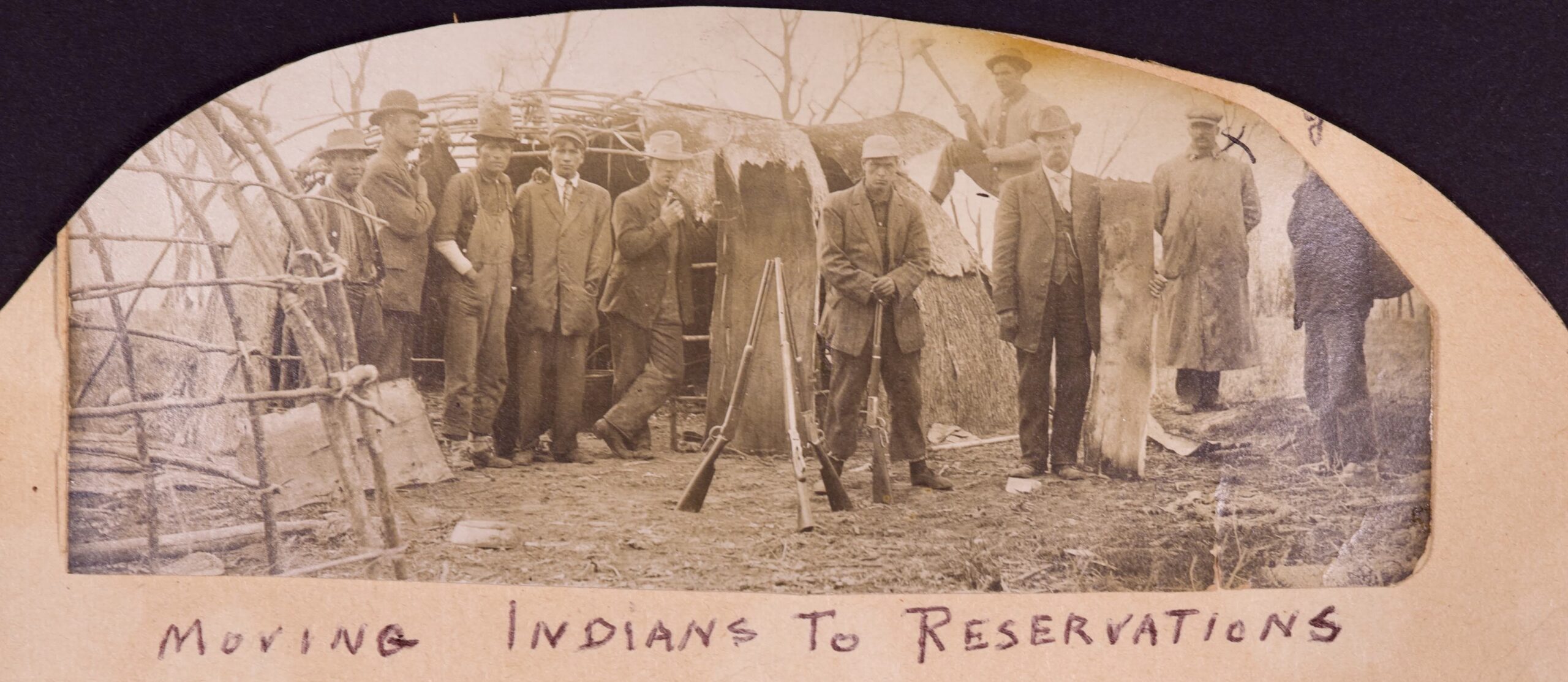
Somewhere between these two narratives is that, after Shockley and seventeen armed hired hands approached Wadena’s village, dozens of villagers disassembled their own birchbark homes and tar-papered frame structures. Then, according to the Pioneer Press, the posse “unroofed and tore down the frame structures, unroofed the winter cabins and piled the logs in heaps,” as Shockley “set fire to the ruined village.” Wadena was put in irons, and watched his home burn down. He and nine families were ejected from the property.
Until now, evidence of this day was scant. Although the Band educates its members about this violence, this history is diluted in vague murmurs among white residents with fleeting knowledge of this past. Among the scraps was a faint mention of the eviction in the Princeton Union: “Sheriff Shockley has some interesting photographs taken while the Indians were being moved from Mozomonie Point,” wrote the newspaper, showing “the raid on the camp and the demolition of the wigwam by the posse.”
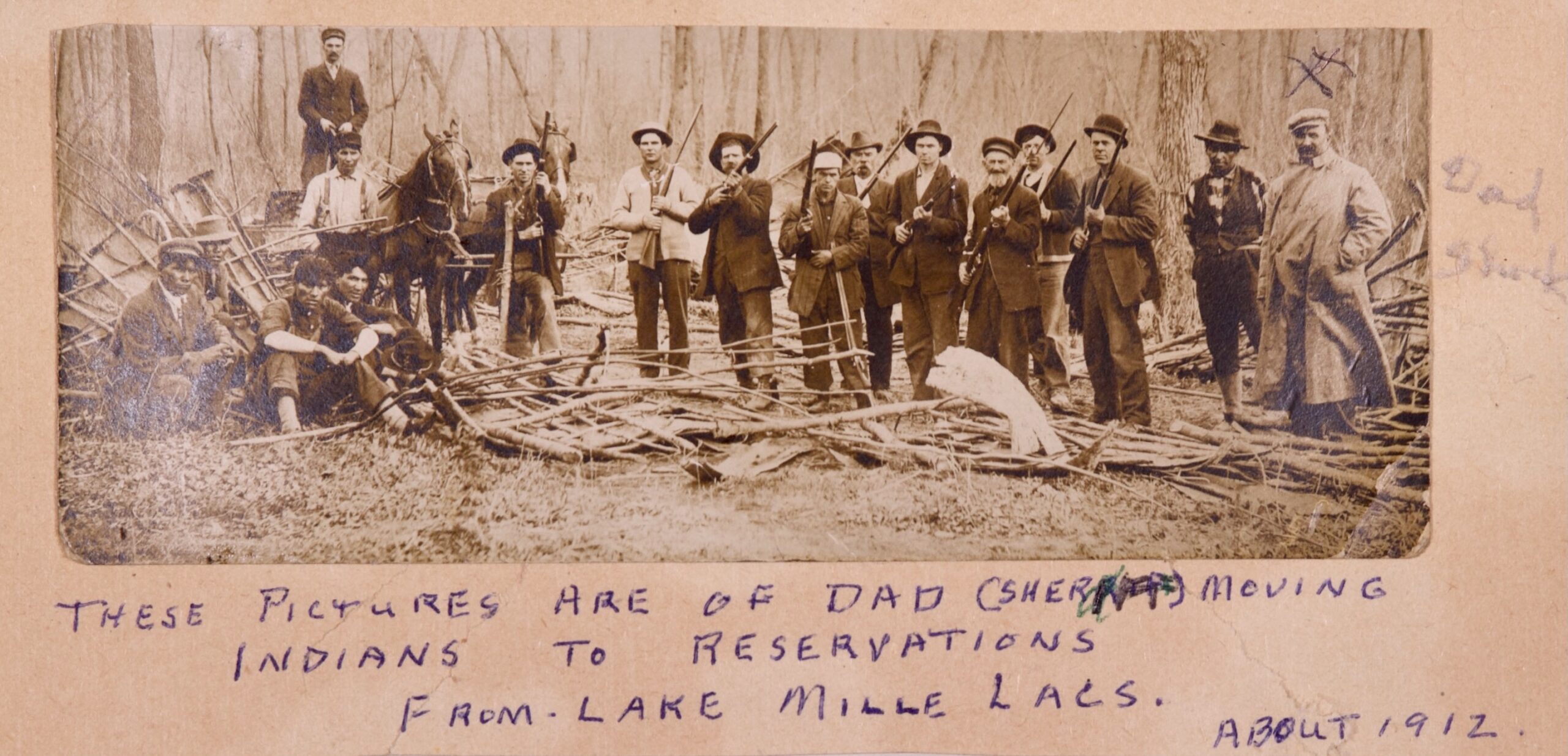
Shockley’s photographs, as it turned out, ended up in the private possession of his descendants. They are three black and white photographs, and details within the images indicate they depict the events of May 4, 1911.
After this era of forced evictions, the Band sued the government for compensation for throwing open the reservation without giving Band members allotments at Mille Lacs. Although they won compensation, the Bureau of Indian Affairs attempted to resolve the allotment controversy by purchasing some 2,000-acres and placing them into trust for Band members. Later land purchases by individual Band members and the tribal government over time added up to the roughly 4,000-acres the County today believes the Band had jurisdiction over.
By the 1930s “the rez” was formed, cementing in many white minds that the much larger original reservation was long gone. But white perceptions of who the Band is and where their home lies are riddled with inaccuracies.
“Everything is about connection”
Grand Casino Mille Lacs—a popular destination with a touch of Vegas—was erected in 1991 on Highway 169, across from the old Indian Trading Post. In 1960, the Minnesota Historical Society had opened a museum next door to the trading post. Its centerpiece is its life-sized diorama, the ‘Four Seasons Room’: a round space, providing a 360-degree view of village settings populated by mannequins at different seasons in 1750.
It is a quaint diorama of frozen-space-time: plasticized reality that at once fills the mind with wonder over the past, but also firmly stamps these people as part of a bygone era. Despite the tendency to describe Ojibwe life in the past tense, however, Band members practice their customs today through traditional and modern methods, still defined by a respect for and relationship with nature.
“Everything is about connection,” said Band cultural advisor Bobby Ogimaa Giniw Eagle. Customs bridge the gap to the spiritually and physically sustaining natural world, where everything possesses a spirit, a legend, and a long-tailed history. But like all interpersonal connections, you need to put in the work to maintain the relationship. “Being Anishinaabe,” Eagle says, “is hard work.”
Whether it’s 1750 or 2026, that “hard work” begins with a tobacco offering. Then you cleanse the nets with burning sage, and when darkness falls you set them in the water just to wait all night and find if anything was caught. Or you gas the boat and, spear in hand, you skewer a walleye as it swims within the boat’s light beams. Then you gut the fish and package its fillets and, in honoring the taken life, you find a use for all that remains. Finally, you share the bounty with the tribal elders and those in need within the community. Or you enter the woods and harvest medicinal herbs and berries, and gently peel away birch bark from the trees to weave and sew into Ojibwe items. In the ricing lakes, you head out in pairs—one guiding the boat through the water and while the other gently knocks out the grains. That rice is dried, parched, winnowed clean in batches, and finally cooked. Among the maple groves you tap the trunks to fill buckets with watery sap, while stoking a fire for days on end to boil hundreds of gallons of sap down to dozens of gallons of golden syrup.
While connection to culture comes with practice, the open engagement of some of these customs experienced a revival only thirty years ago.
The federal government and Minnesota tried to assimilate the Ojibwe into white culture for more than a century. Both governments attacked the merits and values of Ojibwe life: from trying to convert Indigenous harvesters into European-style farmers, to erasing the language by promoting English. Many cultural activities were restricted, if not outright banned. For example, netting was restricted to smaller lakes. Even harvesting on public lands was limited, with the state requiring Band members to obtain permits to collect wild rice.
Still, many families passed along their Anishinaabe traditions by navigating the state’s rules, or in quiet rebellion against them. “All of those traditional foods were always big in my household, because my grandparents were major traditional harvesters,” said Adrienne Benjamin. “My grandpa and grandma always fished and gathered rice, even if it wasn’t still legalized.”
There’s still urgency today among those who grew up beneath restrictions to pass along these traditions to their own children. “When I go out netting,” said Eagle. “I think about the relatives that came before me. I think about the teachings that I’m leaving behind with my children.”
Non-Indigenous eyes often exoticize and fossilize tribal life. In Minnesota, for example, plenty of people believe Band members cheat when using modern tools and methods in carrying out traditions—that Ojibwe life should remain static.
But the Ojibwe change like everyone else. They use motorized boats and nylon nets; they gather with plastic containers and boil sap with metal evaporators. Online, Indigenous people have even turned to artificial intelligence to generate videos demonstrating traditional pow wow dances. “We’re in a time where we’re emerging and we’re relearning about our culture,” said Eagle.
Still, mentioning the Mille Lacs Band of Ojibwe to many Minnesotans conjures a sore topic: the lake’s walleye fishery.
Before the millennium, fishing limits at the lake were few compared to what they are today. But a 1999 Supreme Court decision recognized that the Band still retained resource rights in the lands they ceded in 1837—meaning the state was forced to cooperate with the Band to closely manage the lake’s health and its resources.
To the Band, this was about more than just harvestable resources—it was a struggle to preserve their cultural and spiritual identities in the face of assimilation. A walleye is just a fish to a white person. But to the Anishinaabe people, a walleye is a spirit manifest as a scaly, twin-finned animal. It is as alive as the fisherman and the water containing each.
Since state and tribal authorities constantly study Mille Lacs, the regulations can change—to the fisherman’s chagrin or joy—anytime throughout the year. The Band draws much of the anger generated by poor fishing periods and resulting tight regulations. Some fishermen claim that state and tribal authorities practice poor science when determining limits—especially when walleye catch limits drop to zero. But astute locals can recall many “dead sea” years before co-management of the lake’s fisheries, when the walleye just didn’t bite. Maybe they were overfished; maybe the water was too warm. The lake is a finicky place.
Going “Up North”
On Mother’s Day weekend in early May, flowers are afterthoughts for the roughly 500,000 people awaiting the state’s fishing opener. That Friday they play hooky and drive hundreds of miles, towing boats and campers to get to a lake and a bite at the end of a hook.
Six months later, when a two-foot-thick icy mass has formed atop Mille Lacs lake, fish house villages and trucks parked on the ice dot the horizon. The state’s natural resources department estimated that in 2020 anglers spent some three million hours hovering over holes drilled in the ice.
Despite the numbers of visitors, silence is part of the experience of the lake, with some exceptions. In summer the outboards glide across it, registering a hum that dissipates. In the late winter, when the lake’s frozen cap starts thawing, powerful cracking eruptions randomly break the peace.
Lakes do not just exist in Minnesota—they inform the Minnesotan mindset. Lake life belongs to a greater notion known as “Up North.” That phrase, part of the lexicon, evinces a search for the profound in nature by means of labor and the fleeting moments—with mom, dad, sister, and brother—that transform into lifelong memories.
You go north, inside the woods and along the lakeshore, to open the cabin or pitch the tent or hook up the RV and mow the lawn and empty the septic tank and start the pilot light and flush the water pipes and sweep away the cobwebs and dispose of the mousetraps and make all the beds. There is wood to be chopped and mosquito burners to be ignited and fishing lines to be set and guns to be cleaned and propane tanks to be filled and boat motors to be gassed up. This is the land of simplicity and nostalgia, the times of bonfires and s’mores, of fish and patience. You go “Up North” for rejuvenation, and it stays with you in the stories told by your loved ones and brief hours enjoyed on the lake or hiking through the woods. And by Sunday morning you’re zipping back to the cities to beat the traffic, perhaps spiritually refreshed.“One of the oldest pieces of culture is the pilgrimage,” said David Lanegran, a retired geography professor at Macalester College. “The notion is that by going up north, you’re amused, but you’re also changed by this experience.”
After logging exhausted Minnesota’s forests, in the 1890s the timber industry sold their stump-riddled lands to newly arrived European immigrants, who brought with them a recreational culture fit for the wilderness. Railways and roads climbed northward like ivy and wealthier urbanites, aching for a slower pace, found respite in sleepy locales between the Twin Cities and Duluth. Rural communities began to offer amenities to these visitors, gradually constructing a resort economy in what was advertised as the Arrowhead region. Named after Lake Superior’s point, it stretches from Mille Lacs’ southern shore to the Canadian border, more than 150 miles north.
This era birthed the mom-and-pop resort model, a family-run seasonal business that aided that pursuit of transcendence, with cabins, restaurants, bars, fishing guides, rental boats in summer, and ice-fishing houses in winter. They became part of Minnesota’s culture and everyone had “their spot” where they returned.
Resorts like the Early Bird at Mille Lacs offered seasoned fishing guides and cabin lodging. Others, like Wilderness Beach, operated with a central lodge equipped with a kitchen, dining room, and a bar to enjoy a cold Schlitz on a humid day. Phyllis and Clark Lyback, and their two children, operated Lyback’s Ice Fishing starting in the 1950s. Clark plowed roads onto the ice and dragged out shed-like fishing houses equipped with wooden stoves and hatches for drilling 10-inch holes. Lyback’s survived good years and bad years, and son Eddy runs the business today.
There were more than 3,000 resorts across the state by their peak in the 1960s. Mille Lacs’s own tourism industry peaked by 1970, with roughly ninety-seven resorts, hotels, boat launches, restaurants, and attractions along the lake’s sixty-eight-mile-long shoreline highway.
But eras end. By 2021 there were 625 mom-and-pops left in Minnesota, and today only two dozen remain at Mille Lacs.
Lakeshore property values, and their taxes, outpaced the value of many family businesses. The children who inherited the properties rejected the tiny margins and mercurial fishing seasons. Lots were split and sold to new arrivals who demolished old resorts for new cabins and wanted more amenities, shopping, and entertainment. People still go “Up North”—they just pursue transcendence differently.
These changes have stirred resentments, and some aggrieved locals have sought a villain. They insist that the thinning crowds and disappearing businesses—the demise of an entire culture and history at Mille Lacs—is the Band’s fault.
Phyllis and Clark Lyback’s daughter, Sue, summarized the tensions in a 1997 poem, composed during the region’s most consequential legal drama to date: “Minnesota water — the lake looks pretty calm, but underneath the surface there’s a battle ragin’ on.”
“I don’t think there’s anything the Band could do”
In 1990 the Band sued Minnesota for interfering with its treaty-stipulated harvesting rights at Mille Lacs and across the lands they ceded in 1837. The Band’s intentions were interpreted as focused on the ability to fish the lake without the state’s permission. Still, the lawsuit was a gamble on sovereignty—whether their resource rights across a swath of Minnesota still existed. The suit was later backed financially by the newly-minted casino, which would open a year later.
Initially the state government tried the settlement route, to avoid litigation costs and potentially losing any control over the region’s resources in the courts. So in 1993 the state agreed to recognize that the Band possessed limited fishing harvest rights. But Mille Lacs resort owners, angling groups, and anti-Indigenous activists pressured the legislature to scuttle the settlement.
This coalition, later joined by Mille Lacs County and several other jurisdictions within the 1837 ceded territory, believed later treaties had ended the Ojibwe’s resource rights. To them, tribal harvests, largely through netting, would inevitably deplete Mille Lacs’ walleye fishery. There was also a racial component. “We don’t want to have any special interest groups to have a right that we don’t have,” Bud Grant, a former Vikings coach and an anti-treaty rights leader, said in a 1993 speech.
His comments followed years of strife between anglers and Indigenous fishermen in Wisconsin over the same treaty. Violent fights had broken out, and angry white fishermen often repeated versions of the refrain: “Spare a walleye, spear a squaw.”
In Minnesota, some claimed the fishing rights case was a revenge plot for injustices carried out against the Ojibwe over a century beforehand. “They’re trying to make up for that by clobbering those of us here now,” said Frank Schneider Jr., head of the Minnesota Sportfishing Congress, in 1994 as the case was litigated. “I wasn’t here. My parents weren’t here. My grandparents weren’t here.”
But in 1994, the federal District Court of Minnesota affirmed that the Band’s treaty rights remained intact, and in 1997 the court ruled that tribal members were accountable only to tribal conservation codes—meaning they no longer needed the state’s permission to net and spear fish. Two years later the Supreme Court sided with the Band in a 5-4 decision.
Today, Minnesota’s Natural Resources Department partners with the Band and other tribal authorities to co-manage Mille Lacs lake’s multiple species of fish, with walleye the most desirable catch. Each year, in the face of thousands of anglers, invasive mussels, and farming runoff, these bodies assess the lake’s health and fishery’s size to set daily catch and yearly harvest limits. Once they determine a sustainable total amount of harvestable fish, they divide the annual total between Indigenous and non-Indigenous fishermen. The state’s allocation peaked at 500,000 catchable walleye in 2006; that same year, the tribal harvest was set at 100,000.
But stressors have steadily lowered annual harvests: in 2024, non-Indigenous fishermen were allocated 91,550 walleyes, while Indigenous fishermen could harvest 65,950. To prevent reaching the annual harvest total too quickly—and cause a complete shutdown of the lake—daily catch limits were as low as two walleye per angler in the 2024 summer season, down from six prior to 1999. Since then several walleye fishing seasons have closed entirely and hurt the local economy, despite bass fishing remaining open. Many anglers and local businesses argue that walleye restrictions are based on junk science. The limit dropped to zero as recently as 2020.
Infamously, during a walleye ban in 2017, then-governor Mark Dayton fished Mille Lacs as a stunt to promote its bass fishing, as a walleye alternative. The stunt was quickly overshadowed when his vessel was circled by a flotilla of some thirty fishing boats protesting the walleye restrictions with signs and shouts.
Everyone largely agrees the buck stopped at the Supreme Court in 1999, yet resentments linger, and some locals view the decision as a loss to the general public’s freedom for the sake of tribal interests. “I just have a hard time understanding, above the Supreme Court building, inscribed above there, ‘equal justice under the law,’” said resort owner Joe Karpen, following the 1999 ruling. “I’m wondering how can we have ‘equal justice’ with two sets of law.”
In a press conference after the 1994 ruling, Don Wedll, then the Band’s natural resources commissioner, lamented that opponents would not move on and would “never be satisfied.” He added: “I don’t think there’s anything the Band could do, except move to Mars, that would satisfy these individuals.”
“That’s what comes with Indian Country”
Indeed, some of those people still don’t seem inclined to give up.
That includes the members of Proper Economic Resource Management, a conservation group founded in opposition to tribal resource rights with close ties to angling groups and Mille Lacs lake businesses. It operates alongside the Citizens Equal Rights Alliance, which formed in the 1970s to oppose tribal water rights in Montana. The Alliance has since spread its advocacy to communities across the country with nearby reservations to make the case to locals that federal tribal policies discriminate against non-Indigenous people.
These groups and others are either 501(c)3 or 501(c)4 nonprofits, and their missions include promoting conservation, defending “constitutional rights,” and educating the public about how “federal Indian policy is detrimental to harmonious existence in our communities,” as the Mille Lacs Equal Rights Foundation, a sister organization to the Citizens Equal Rights Alliance, puts it.
“The biggest thing that we see is different rules on the same land by skin color,” Douglas Meyenburg, president of Proper Economic Resource Management, said in an interview. “What’s that? Apartheid. This is reversed a little bit, but if you look it up in a dictionary, I’m sure it’s awfully close to the same meaning.”
Apartheid isn’t a throw-away term to this coalition. Some locals allege that tribal speeches have revealed that the 61,000-acre reservation dispute is a ruse to steal back the lands that white settlers stole from the Band, and to discriminate against today’s white residents. Proper Economic Resources Management and the Mille Lacs Equal Rights Foundation filed a legal brief in support of the County’s appeal in the policing interference case, stating that federal Indian policy is a means for the expansion of the “power of the United States against the States and people.”
The coalition has warned that judicial recognition of the Band’s reservation endangers the public, and at least two members of these groups later served on the County’s Board of Commissioners. Neither responded to multiple requests for an interview. But Randy Thompson, the County’s private counsel, laid bare much of their fears. “If it’s Indian country, you have federal jurisdiction displacing state jurisdiction in certain areas. You’re dealing with the EPA out of Chicago rather than St. Paul. You’ve got different permitting requirements and standards.”
“Tribes are trying to expand their jurisdiction over non-members and their lands,” he said. “If you believe in a representative democracy, you don’t believe you should be subject to a government in which you can’t participate. That’s what comes with Indian Country.”
Does it?
Fresh off the Supreme Court ruling on the Band’s resource rights, in 2000 the County Board of Commissioners tasked its chief law enforcement officer, then-County Attorney Janelle Kendall, with investigating what civil and criminal authority the Band would theoretically have over non-Indigenous people inside a recognized reservation. The move backfired because of the answer: not much.
In 2001 Kendall authored a memo and reported her findings publicly to the board. “What they can do, even if it is a reservation, is a lot less than people think they can,” Kendall told the commissioners during the presentation.
She found tribes generally can’t tax people who aren’t members of the tribe, nor can they assess or impose property taxes on non-Indigenous people outside of trust lands. Non-Indigenous people would continue to only be liable to local, state, and federal taxes—and non-trust lands would remain on the County’s tax roll. Outside of trust lands, the Band would possess little zoning authority. And though tribal police can enforce the state law, short of a violent crime involving a tribal member, the Band can’t generally prosecute non-Indigenous peoples.
Kendall’s memo closes with a warning that “widespread misinformation” about the Mille Lacs Band had led to public safety concerns and potential unrest.
The County Commissioners dismissed her findings. Then-commissioner Frank Courteau, formerly a board member of the Citizens Equal Rights Alliance, had already made up his mind that a reservation was a threat to the community. “I think a fear people have is that given the economic realities, there will be a slowly tightening noose around the necks of non-Band members,” he said in 2001.
Courteau, who grew up in segregated Rhodesia, is one of the first locals to introduce “apartheid” to the local lexicon. He and the board sued the Band in 2002 for criminal and civil jurisdiction interference, saying the Band’s claims to a 61,000-acre reservation created a legal controversy. Their lawsuit was joined by the First National Bank of Milaca, a local bank in the County. “My singular concern is that I do not wish to live, own property, or do business on a reservation,” said Pete Allen, former chairman of the bank.
But the state and federal judicial system threw out the lawsuit and the Supreme Court declined to hear it.
“The settlers are not savages”
Decades of lawsuits, including this latest 2017 litigation between the Band and the County, have taken a toll on the lake’s communities.
Driving northbound on Highway 47 toward Isle, one eventually reaches a massive evergreen highway sign bearing the Band’s seal and reading, “Misi-zaaga’iganiing: Mille Lacs Reservation, Established in 1855 Treaty.” The state erected six of these roadway signs in 2021 to demarcate the 61,000-acre reservation’s boundaries.
And as recently as July of 2025, this sign was riddled with bullet holes and dents where the slugs failed to pass through. Mille Lacs County Sheriff Kyle Burton warned in an email against rushing to judgement about the meaning of riddled road signs, writing that “signs of all kinds, not just reservation boundary ones, get shot quite regularly.” Indeed, a dozen or so feet away a yellow two-way sign bears some gunfire wounds.
Still, at the same time in 2025, and twenty miles away, the eastbound reservation boundary sign on Highway 23 outside Onamia was the only sign damaged by gunfire in at least a mile in either direction. Even the Mille Lacs County boundary sign, roughly a hundred or so feet away, is free of blemish.
Locals might call it cherrypicking, but there are other signs of anti-Indigenous actions around the lake. Multiple Band members in interviews recalled being harassed by whites on the shoreline while fishing in the spring. In one instance in 2021, a man was charged with felony harassment and indecent exposure after yelling racist profanities at a family.
Online vitriol is unending, meanwhile, and just about any controversial topic on the Mille Lacs Lake Facebook page invariably possesses a comment blaming the Band. You can also hear things in casual conversations. Out on the lake, a local mentions that mixed-race people don’t survive past their fifties—because Indian and white bloods “don’t mix well.”
And outright violence is not as distant in history as one might surmise. Suspect land claims led to two villages being torn apart and their residents evicted in present-day Isle in the 1890s and in 1901, according to historian Bruce White’s book They Would Not Be Moved. The second instance led to the displacement of twenty-five families when Mille Lacs County Sheriff Edward Claggett burned down dozens of birchbark houses and log shacks.
And then there is 1911, mentioned above. Among the photographs belonging to Claggett’s successor, Harry Shockley, depicting the 1911 forceful eviction of Chief Wadena and his clan, is an image of a posse loftily bearing their rifles upward toward the sky amid a wrecked village. Four Indigenous men sit on the ground ahead of the wreckage of an upturned structure, whose inner branches moan toward the sky like a ribcage. There are broken sticks and branches all over the ground, the foundational bits of homes and dwellings torn asunder. On the far right, in a trench coat and cap, Shockley stands astride the day’s mess.
Two months after Chief Wadena’s village was destroyed in 1911, another village ten miles away in Wigwam Bay, consisting of “a frame house, several log huts and wigwams,” burned to the ground in the middle of the night while its chief was strapped to a tree, as recounted by White. The local Princeton Union newspaper dismissed arson as the cause and claimed “the settlers around Mille Lacs are not savages and they have never dealt harshly with the Indians.”
“There is no land left” for the Band, the paper continued, “and it would be far better for them if they were to join their brethren at White Earth.”
Eighty years later Scott Coffman, then a teacher in Isle, witnessed mob-like frenzy at a town hall meeting in the high school’s gym. The now seventy-year-old retiree recounted that local politicians, there to inform residents about the ongoing fishing rights case, instead inflamed the mostly white audience’s fears with dubious tales of the risks of living under tribal sovereignty.
The tensions that fuel such incidents are still around. “There’s a lot of resentment out there driven by lake co-management” from the 1999 case, said Joe Fellegy, a former fishing guide. “People are wrong when they link the decline of mom-and-pop resorts and tribal stuff.”
But he, like many locals, feels treaties are archaic and ignite community tensions. “The 1837 Treaty is irrelevant today. How long should this co-management go on?”
“Now they want to expand “the rez” fifteen times, from several thousand acres to 61,000 acres,” he said. “Years ago, people never thought that Onamia and Wahkon and the other towns were in an Indian reservation. Is there any reason to bring back an old reservation?”
“Everybody on that social ladder shifted”
While race factors into tensions between the Band and local whites, something else may be at the root of the matter.
Every March, when the fish houses have been drawn to shore and sap runs through the maples, the Band commemorates the 1999 Supreme Court ruling with ‘Treaty Rights Day.’ They hold speeches, a raffle, and host lunch in Mille Lacs Grand Casino’s convention center off of Highway 169.
The celebration is really more of a community gathering. Some 500 tribal members at fifty tables socialize with family and friends, eat alongside their neighbors, and commune with their elders. But the room is silent as Joe Nayquonabe Sr. gives the convocation in Ojibwe from his red scooter.
He lingers in the convention room after everyone else has left, perched beneath nine massive portraits of Mille Lacs leaders dating back to 1855. Around him, white and Indigenous workers clear the room of trash, chairs, and tables.
Nayquonabe, who died not long after 2025’s celebration, recalled there was more trust among Band members and among white locals when he was growing up. Now he felt a sense of unraveling.
Back in the day, he said, widespread rural poverty throughout the reservation bred a sense of shared responsibility. Although a kind of physical segregation existed at Mille Lacs—unenforced, but still determining where people lived—Band members and whites alike shared stories of neighborliness. There are many tales about white property owners letting Band members enter their lands to hunt, often leaving behind meat to share.
But assimilation and racism were also part of life at Mille Lacs, driving a sense of status.
For decades, Band members like Bette Sam and Shirley Amikogaabowiikwe Boyd, both in their 80s, attended a three-room Indian school run by the Interior Department in Vineland until the eighth grade. They were forced to learn in English despite Ojibwe being their native language. Still, inside the classroom and outside school they were among supportive peers in a tight-knit community.
But innocence receded once they began attending the public school system in Onamia and Isle, typically beginning in middle or high school. Band elders described being thrust into an adversarial environment, full of verbal and physical bullying aimed at Indigenous students.
Fights among young Band members and white students were frequent, although discipline, they said, often fell upon the Indigenous participants. Don Wedll, a white man who taught Ojibwe students on the reservation starting in 1972 and later administered the Band’s cultural school, told the St. Cloud Daily Times in 1983 that in his experience, “if there is room full of students throwing wads of paper, that one dark-skinned arm is likely to stand out in a roomful of white arms.”
Wedll articulated at the time that local prejudice was not of the Klan variety, but subtler, with the expectation that “Indians must stay in their place in the economy.”
Nayquonabe, reflecting on his time at Onamia High School, said “I always tell people I didn’t know how to fight until I went to Onamia. By the time I was a junior or senior, I was pretty damn good.” He added that he believed Indigenous girls often bore the brunt of slurs and bullying.
Two years after the Wounded Knee standoff in 1973, a pivotal moment in Indigenous activism, forty-three Indigenous students at Onamia High School walked out in protest of physical bullying and verbal harassment, including being called “squaws,” “comanches,” and reportedly told to “get their tomahawks” according to contemporary reporting. The Band responded by founding its own school system several years later, based around cultural education.
However, many Band members have still enrolled in the area’s public schools, though they say little has changed in attitudes among their white peers.
Melanie Benjamin, a former Band chief executive, said that a white resident once described to her the unspoken dynamic at Mille Lacs. They told her many white people “grew up very poor. But the one thing about their family: of their neighbors, they weren’t the poorest. It was the Indian people that were the poorest.”
All that began to change when the lakeside casino opened in 1991.
Tribal gambling took off after the Supreme Court ruled in 1987—in a case not involving the Mille Lacs Band—that tribes, as sovereign nations, have an inherent authority to establish and regulate gambling in their territories. Congress then passed the Indian Gaming Regulatory Act, which created a federal, state, and tribal framework for regulating gaming of any kind, from scratch-offs to poker. While tribes can play traditional Indigenous games of chance or pull-tabs without outside regulation, tribes need to enter into agreements with their states to open casinos.
Today there are nearly two dozen tribal casinos in Minnesota that raked in $1.6 billion in 2022, according to MinnPost. The Minnesota Indian Gaming Association estimates that after fees, debts, and operating costs the house keeps 10% of the gross wagers. Tribes do not have a monopoly on all gambling—the state administers a lottery, and small businesses and nonprofits can run bingo games and sell pulltabs—but tribes in the state have solely held permits for the grander operations like the one at Mille Lacs today.
The Band opened Grand Casino Mille Lacs on “the rez” in 1991, and the next year it opened a second casino fifty miles away.
Locals objected. Long-time resident Sue Lyback noted many people were initially put off by gambling because of their conservative Christian backgrounds. It did not help that the white mom-and-pops were dying off around the lake while tribal fortunes were suddenly improving. Even worse, the gaming revenues were paying for the Band’s 1990s lawsuit to force Minnesota to recognize their resource rights to the lake.
The casinos “stirred up a lot of controversy,” according to Scott Coffman, the former Isle teacher, and people felt “ the Indians were getting something that we can’t have. People in the area were complaining that a lot of the tourist dollars were going to that side of the lake.”
He was correct that the gambling business has thrived. One consequence, according to the Federal Reserve Bank of Minneapolis, was that median household incomes in “the rez” increased 213% from 1989 to 1999, or roughly from $9,700 to $30,000.
An unknown amount of the gambling revenue is shared with individual members, but much of that money was invested in “the rez” to fundamentally change its character. Gaming money paved roads; built houses, community centers, health clinics, and ceremonial gathering places; and invested in the County’s nonprofit health care system for white and Indigenous patients alike.
Cultural education also remains a priority. The Nay Ah Shing Schools teach cultural activities and customs that might otherwise fade away, including partnering students with fluent or first tongue speakers. The Band recently partnered with Rosetta Stone to create a language teaching program that preserves spoken and written Ojibwe.
Although pockets of blight exist today in “the rez”—boarded windows and vacant lots—they are indistinguishable from blight elsewhere in rural Minnesota. For the most part, the post-casino “rez” looks like the rest of rural America: the streets are organized and paved, with lawns, boats, and RVs in the clearings beside homes and car repairs underway in driveways.
The two casinos employ some 2,500 Band members and non-Indigenous people alike, according to the Band’s corporate website. A 2011 state report found the Mille Lacs casino was the largest employer in the county, and prior to the pandemic the Band was its largest taxpayer.
The timing of the Band’s resurgence only put into focus a perceived decline in the white community: the threat of public schools closing, mom-and-pop resorts shuttering, older families priced out.
“Everybody on that social ladder shifted,” as former Band chief executive, Melanie Benjamin, put it over breakfast in the casino. As the slot machines started spinning, “the Mille Lacs Band had job opportunities, housing, and health care and educational benefits. So they moved up, and somebody had to move down. At least that’s what they thought.”
Many locals characterize the Band and its casinos as a big-money force that disproportionately influences state politics. But the casinos brought benefits for non-Indigenous locals too. Melanie knew her breakfast server that morning, an older white woman with whom she shares a quick chat. “She’s been working for this facility for years and years. It provides health. It provides educational opportunities. And this region never had it before.”
After he was elected to the County’s Board of Commissioners in 2022, Dan Whitcomb was the sole vote against appealing the twin Minnesota District Court rulings: that the 61,000-acre reservation remained intact, and that the County had interfered with the Band’s sovereignty. A blueberry farmer with ties to the region dating back to the 1800s, he attacked the ongoing lawsuit during his campaign as costly and needlessly extended by the County’s actions.
He empathized with the Band’s pursuit of self-determination.“They’re trying to preserve their culture and heritage,” he said at his farm in Princeton, some 40 miles from the reservation’s boundaries. “When we expanded our country, our government agreed to give privileges and sign treaties with these people, unlike Europe and their wars. That’s our heritage, and that’s something that we should be proud of.”
“Ambiguities abound”
In February 2025, the Eighth Circuit Court of Appeals dismissed the County’s appeal against rulings that determined the 61,000-acre reservation was intact. The court determined the policing dispute was resolved because changes to Minnesota’s criminal codes meant the Band was no longer required to enter a mutual aid agreement with the County. As a result, the Band can investigate crimes as an arm of the state’s law enforcement capabilities
Crucially, since an outside force remedied the original injury, no one is at fault. The judges determined the case is moot.
But because of mootness, and the desire to wipe the judicial slate clean if another controversy arises, the Eighth Circuit threw out the lower District Court’s two rulings. So although the Band can now police the entirety of the 1855 reservation alongside the County, the sole judicial recognition that their old reservation still exists is now gone.
In their ruling, two of the judges mused that the case’s evidence suggested the larger reservation had been destroyed or diminished in size by treaty. However, they also pointed out that the evidence might support the opposite, writing that “given this complex history, ambiguities abound.” The third judge objected to leaving any case analysis in the record to allow “a subsequent court to wrestle with the record.”
A return to ambiguity could have been the end after decades of tension, years of litigation, and millions of dollars in legal fees. Elections in 2025 brought a new mix of County Board of Commissioners, who subsequently appointed two members to liaise with the Band and build a cooperative relationship.
But then, nearly a year to the day of the moot decision, the Commissioners petitioned the Interior Department to withdraw its 2015 determination that the 1855 reservation remained intact. The County cited the non-binding analysis proffered by the two Eighth Circuit Court judges as evidence of faulty logic within the Interior’s official position. They requested that the agency instead readopt a 1935 department opinion which says only the several thousand acres of trust lands can be considered the Band’s current reservation. However, this opinion’s analysis is short and dated, and seems out of step with modern interpretations of Indian law.
Board of Commissioners chair Genny Reynolds said in an interview that the petition is meant to realign the federal government’s current position with new legal analysis from the courts, adding that, “we do not want to litigate anything.”
Following the decision, according to her, the reservation boundary signs erected by Minnesota in 2021 remained front of mind for constituents. “The residents up there kept asking, ‘when are those signs going to come down? If they voted pretty much in your favor, then why are the signs still up there’.”
Reynolds also downplayed the petition’s potential impact. “We’re all in the same boat. That’s the way we’d like to be in Mille Lacs County,” she said. “This resolution shouldn’t harm anyone.”
The County said in a press release that while its actions “may create short-term tension,” it still “recognizes tribal sovereignty” and values its “government-to-government relationship with the Mille Lacs Band of Ojibwe.”
The Band responded in a statement to Minnesota Public Radio that the resolution “undermines months of government-to-government engagement,” and that “reopening long-settled federal law through misleading arguments is inconsistent with good-faith relations and threatens the progress we were starting to see.”
The Band’s chief executive, Virgil Wind, said in a taped speech following the Eighth Circuit’s decision that he was confident that the Band would prevail if the 61,000-acre reservation’s existence was re-litigated. “We will keep fighting for our land, our people and our future. This ruling does not change who we are,” he said. “We are now, and always will be, the non-removable Mille Lacs Band of Ojibwe.”
The Fourth of July
Not much has changed at Mille Lacs. Despite a nearly decade-long lawsuit, the 61,000-acres reservation’s boundary signs are still up and people more or less go about their lives. The walleye are biting, albeit slowly, so by summer’s end in 2025 the daily catch limit was to be increased from two to three.
Although some locals worry about living within a sovereign nation separate from the U.S., on Independence Day this slice of rural America looks just like that.
On July 3rd, at a junction of roadway work on Highway 169, the two-lane is stop-and-go as thousands race towards the lake for the holiday weekend, with boats and RVs and nascent memories in tow. On “the rez,” children play in kiddie pools and teenagers light off fireworks at night.
By Independence Day, a flotilla of revelers in Wigwam Bay forgo fishing in the heat for cooling down in the lake. Some people brave the waters in a launch boat with dozens of others or privately in their fiberglass-frame vessels, with a cooler full of Budweiser, rocked by the current or tantalized by the wait for a walleye’s nibble. People dressed in tricolor Americana peruse the few shops and restaurants along Isle’s Main Street; they buy out the caramel rolls from the local bakery and turn the grocery into a zoo. Charcoal and grilled meats perfume the lake breeze in Wahkon.
What’s changed the most through the years are the people. The long litigation outlived multiple members of the community, Indigenous and white alike. Opinions remain entrenched among certain pockets around the lake, and yet a new generation of leaders has stepped into power and some of its members are trying to forge new relationships.
Meanwhile, some hair has grown lighter and thinner. Wrinkles have accumulated. Some feet shuffle more than walk, and bodies are conveyed in motorized and manual wheelchairs. People tired of winters have flown the coop forever, but others choose to suffer through the seasons, and visit the lake when they can. New and younger families buy lots and construct their own slices of paradise. Resorts shutter and new homes sprout up along the shoreline. Family names and local institutions fade from memory, but fishing records remain forever. There are dead sea years and decades of good fishing. Children grow, the old die, and Mille Lacs abides.
Allan Kew is a research editor at The Week and a freelance journalist. He previously covered the aftermath of the Maui wildfires for Honolulu Civil Beat. In 2023 he graduated from Columbia’s School of Journalism, where he won a Pulitzer Traveling Fellowship grant that funded the reportage behind this story.